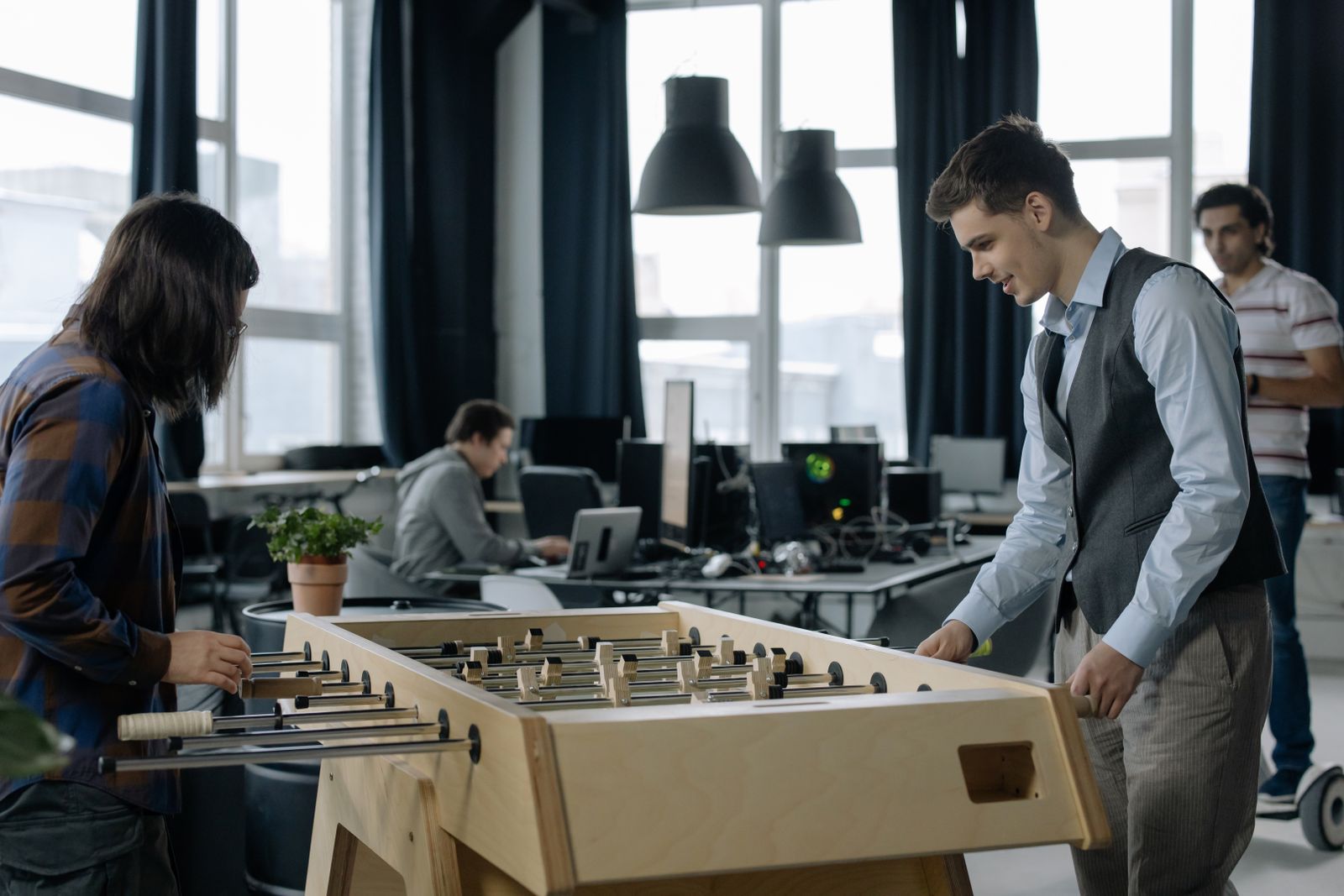
A team event turns awkward the moment people are made to do something they did not choose themselves. The compulsory circle where everyone says a few words about themselves, or a game that requires physical contact with a colleague — those are remembered for all the wrong reasons. A good format gives people something to do while they talk, and leaves them a choice. Below are ten formats that genuinely work in Estonian teams, plus the practical side: how to build an event out of them.
Three reasons come up again and again. First, forced participation: if stepping aside is visible to everyone, the quieter person feels bad for the entire evening. Second, empty time — standing around with a glass in hand, waiting for something to happen. Third, the wrong pace: a training session in the morning and a party in the evening on the same day simply wear people out, and in the end neither is remembered.
The fix is not more programme, but a clearer structure. One activity that gets people moving, one place where they can talk calmly, and one point that guests walk up to on their own. The rest takes care of itself.
It is also worth remembering that a team event does not have to solve management problems. If there is real tension in the team, it will not disappear over a shared dinner or a city game — that gets resolved elsewhere. The job of the event is more modest, and entirely sufficient: to give people a chance to see each other outside their work tasks.
Movement works when the team is large, or when people have been sitting all day. The important thing is that the activity requires neither good physical fitness nor special equipment — otherwise part of the team is automatically left out.
If people work from home or from different cities, the value of meeting lies in simply being in the same room — the programme can be lighter.
Go through the schedule hour by hour and mark the spots where nothing specific is happening. There are usually two: the arrival, and the hour after the meal.
The most common mistake is leaving the middle of the evening unplanned. The programme is over, the food has been eaten, but nobody is going home yet — and that is exactly when the mood sags. What helps is a point that people walk up to themselves, without anyone inviting them.
A photo zone fills that role most easily. A photo booth takes up about one square metre, the backdrop is 1.5–2 m wide and 2.5 m high — it fits into a smaller room too. Guests see themselves on the screen, pose together and get a printed photo straight away to take home. Props help the ones who freeze in front of a camera. We have compared the options in the post Photo booth, photo mirror or 360°? How to choose.
The second useful detail is a shared result that outlasts the event. A photo everyone received, one picture of the whole team, or a short video — something you can use later on the intranet or in a welcome email to a new colleague. It costs little, but it extends the effect of the event far beyond that one evening.
Many companies hold one team event in the autumn and a Christmas party in December. The two do not have to resemble each other — on the contrary, the contrast works. If the autumn event is active and takes place during the day, the December one can be calmer and more formal. Christmas party themes are collected in the post Christmas party themes: 10 ideas that are not worn out, and the preparation steps in the organiser’s checklist.
Autumn is the busiest stretch of the season, and December Fridays fill up as early as September and October. The format can still be open — the date cannot. PicMe is a local Estonian team that has been serving events for over five years and works across the whole country: Tallinn, Tartu, Pärnu, Narva, Kohtla-Järve, Jõhvi, Viljandi and Rakvere.
Send us the date, the venue and the number of participants — we will recommend a suitable solution and send you a quote. Request a quote and book your date.
If you want a photo zone that guests gather around on their own, take a look at photo booth rental in Tallinn — prices start from 250 euros.