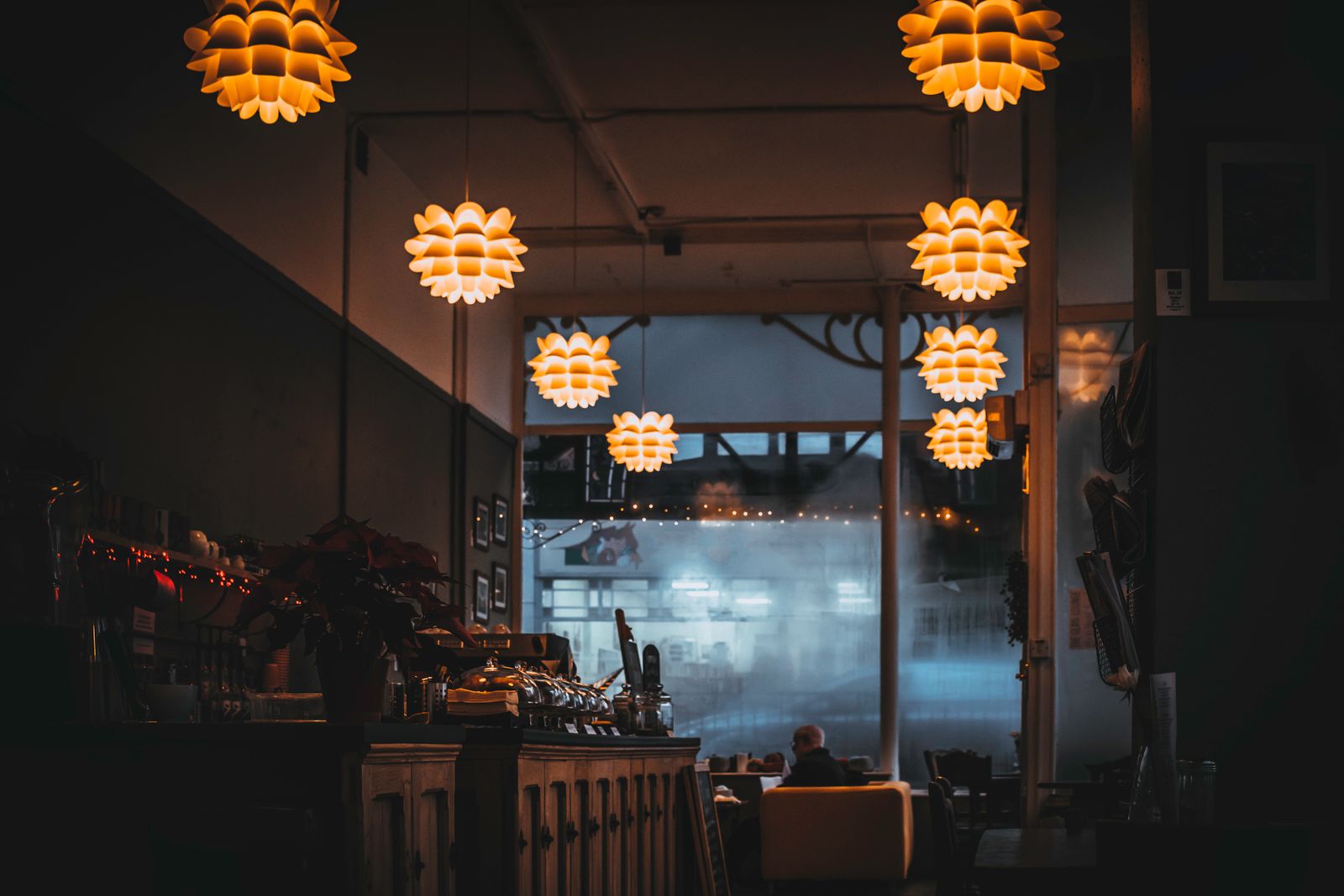
In the venue, the photo zone looks exactly as planned: the backdrop is up, the props are laid out, the guests are laughing. The next morning you open the gallery and find that half of the shots are dark, grainy and tinted an odd shade of yellow. In most cases the camera and the guests are not to blame — the light is. Here is why it happens and what an organiser can do before the event even starts.
Lighting in a party venue is designed for atmosphere, not for a camera. Dim rooms, a few warm ceiling lamps and candles feel cosy to the eye, because human vision adapts to darkness within a couple of minutes. A camera does not — to a camera, a cosy room is simply a dark room.
At winter events in Estonia the conflict becomes sharper still. The party starts after dark, no extra light comes in through the windows, and the entire room is lit by a handful of decorative fixtures. An expensive camera does not rescue the situation: if there is no light, even the best lens has nothing to work with.
In low light a camera has only three options, and each one has a price:
The camera’s automatic settings make these compromises quietly at every event, and nobody notices until the photos have already been taken. The only way to avoid them is to give the photo zone its own light, independent of whatever is happening in the room.
The most common mistake is not a lack of light but its direction. Ceiling lamps and venue spotlights light people from above. Dark shadows fall under the nose, into the eye sockets and under the chin, hair comes out bright and the face comes out dark. Even in a well-lit room, a portrait taken this way looks tired.
Light for a photo zone should come mainly from the front and slightly above, roughly at the eye level of a standing person. The larger and more diffused the source, the softer the result: shadows become gradual, skin looks more even, and small reflections appear in the eyes that bring the face to life. That is exactly why diffused LED panels and softboxes are used rather than a bare lamp.
How much light you need also depends on what is being captured. A photo mirror shoots in a vertical frame and full height, which means a person has to be lit from head to toe, not just at shoulder level. A 360° video camera records in slow motion, and slow motion needs a shorter shutter speed than a normal photo — so a 360° platform usually needs the most ambient light of all. In a dark room, slow-motion video is the first thing to turn grainy.
The second common problem is colour temperature. Incandescent bulbs, candles and warm decorative lighting give off a yellowish light, while LED strips, screens and coloured effect spotlights give off a bluish or even greenish one. A camera can only set its white balance for one source. When there are several, part of the face turns orange and part of it turns green, and no amount of editing will properly fix it afterwards.
The solution is simple: keep the photo zone away from coloured effect fixtures and let one type of light do the work. Disco lighting belongs on the dance floor, not in the photo corner.
If you light only the person, the backdrop stays dark and loses its texture. A typical photo zone backdrop is about 1.5–2 metres wide and 2.5 metres high — a large surface that will not brighten by itself. This matters most for glossy and sequin backdrops: the sequin “living backdrop” (a 150 € add-on at PicMe) lives entirely on light bouncing back off it. Without light, a shimmering backdrop becomes plain grey fabric in the photo.
In practice this means one source for the person and a little separate light left for the backdrop. If you light the backdrop exactly as strongly as the person, depth disappears and the image goes flat — a small difference should remain.
Agree on the location of the photo zone before the equipment arrives, because moving it later is a nuisance. Three things that matter in terms of light:
The space requirement itself is modest — a photo booth takes up about one square metre — but a couple of metres of clear floor have to be left in front of it for the light and the guests.
Heavy smoke adds depth to a frame and makes beams of light visible, which is why it works very well in a photo zone. Just do not overdo it: fog that is too dense scatters the light and the image turns milky and flat. The best result comes when there is just enough smoke to flow along the floor without covering the person.
The second thing that often goes unnoticed is mirrors, glass doors and lacquered surfaces behind the photo zone. They reflect light straight back into the camera and leave a bright patch on the photo. Before setting up, it is enough to take a quick look at what is behind and beside the backdrop.
When the light is right, most other complaints disappear as well: the photos come out sharp, skin tones look natural and the backdrop looks the way it actually does. A good starting point is working out which equipment you need at all, and this comparison of the photo booth, photo mirror and 360° video camera helps with that. For more seasonal examples, see the articles on the Christmas party photo zone and on the programme, light and photo zone of an autumn event.
Planning an event and want the photos to come out well even in a dark room? Write to us and we will put together a photo zone with lighting to suit your venue — request a quote here.