Autumn is a surprisingly good season for events in Estonia. The rush of summer days is over, the Christmas party season has not started, and good venues and equipment are far easier to book from August to October than in December. Technically, though, an autumn event is harder than a summer one: there is less daylight, the weather is unpredictable and the evening moves almost entirely indoors. Here is a practical guide to thinking an autumn party through so it does not end up half-finished.
An autumn event has three clear advantages. First, people are back from holiday and attendance is better than in July, when half the team is scattered. Second, weekends in September and October are not booked as tightly as December ones — there is more choice in venues and in suppliers. Third, autumn suits a format that is difficult in summer: a long dinner, a calm programme and conversation. In summer everyone wants to be outside; in autumn even eight hours in one hall works, provided the hall has been thought through.
Autumn also makes room for many different occasions: a company season opener, a client day, a birthday, a late-summer wedding, an after-party following a hiking day, or simply a team get-together before the end-of-year pace begins.
This is the most common mistake in an autumn schedule. In early September it is light in Estonia until eight in the evening, but by late October it is dark before six — and in 2026 the clocks go back to winter time on the night of 25 October, shortening the bright part of the evening by another hour. If you are planning an outdoor section, welcome drinks on the terrace or a group photo in front of the building, put them at the very start of the programme.
A practical rule: check in advance what time the sun sets on that date, and assume you have usable light for about half an hour before sunset and almost none after it. Everything that needs natural light has to be done before that. Everything else needs a lighting plan.
At an autumn event the hall’s own lighting is often too dim and too yellow. Candlelight and warm pendant lamps look beautiful to the eye, but a phone camera turns them into a noisy brown mass. The solution is not to switch everything on at full power, but to split the light into layers: dimmed general light overhead, warm light of its own on the tables, and a separate, properly lit spot where the pictures are taken.
That is why a photo zone or photo booth is worth lighting separately. A professional photo booth brings its own light and does not depend on the venue’s lighting — in autumn that matters far more than in summer, when daylight comes through the windows anyway. Order only a backdrop and count on the hall lights, and you will most likely end up with dark pictures.
An hour-by-hour plan is easier to build if you think in blocks rather than minutes. A sample breakdown for an evening event starting at 18:00:
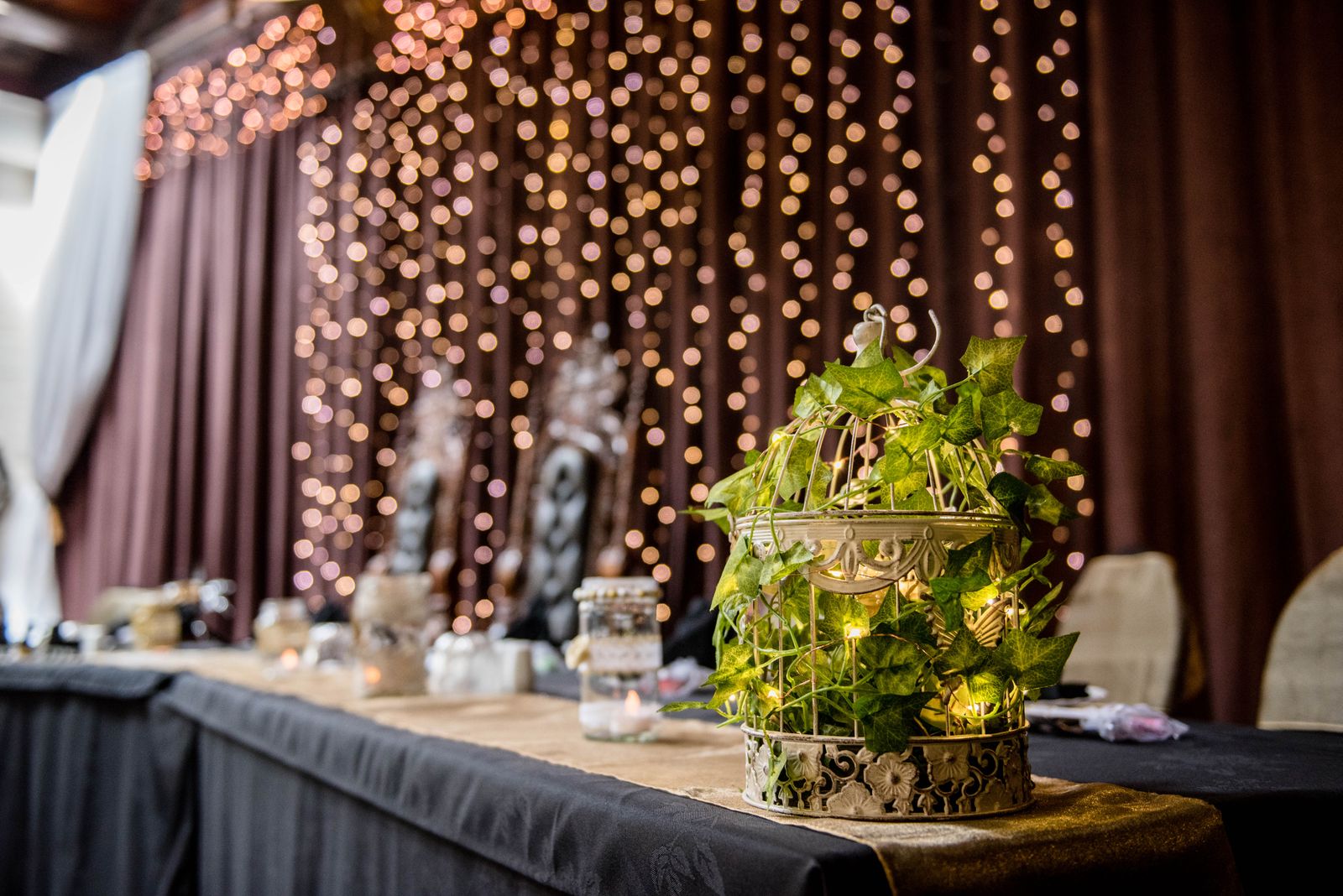
An autumn look in Estonia rarely means orange pumpkins. A restrained palette works much better: dark green, brown, bluish grey, milky white and one metallic — copper or gold. A sequin backdrop fits well here, because in a dark hall it gives the picture sparkle without any separate décor built onto it; PicMe offers the sequin backdrop, or living backdrop, as an add-on at 150 €.
Think about space too. The booth itself takes about one square metre and the backdrop is usually 1.5–2 m wide and 2.5 m high — so with the posing area you realistically need three to four square metres and a wall with no walkway past it. Autumn adds one more thing: the cloakroom and wet shoes must not end up beside the photo zone, or every picture will have bags and coats in the background. More backdrop ideas are in the post about the Christmas party photo zone, where the same principles of light and backdrop apply.
The choice depends on what the guest should be holding at the end of the evening, or seeing on their phone.
If you are unsure which fits your hall and your crowd, a comparison of the photo booth, photo mirror and 360° will help. Besides the equipment, it is worth asking one supplier for sound equipment, a host or DJ and a photo zone at once — one responsible party means one set-up window and one contact during the event.
Agree four things with the venue in advance. First, the set-up time: equipment usually needs at least an hour to an hour and a half before guests arrive, and that has to fit in before the hall is laid. Second, the entrance — in autumn the car park is dark and slippery, so find out whether the equipment can be driven to the door or has to be carried. Third, power: an ordinary 220 V socket near the photo zone, not an extension lead across the dance floor. Fourth, a fallback plan — if any part is planned outdoors, settle who decides to move inside, and by what time.
At an autumn event a printed photo is an especially good idea, because it is the one thing the guest takes into a dark evening. Digital copies are worth arranging too: an online gallery, a QR code on site or pictures sent by email. How that works in practice is set out in the post on sharing photos with guests. Make the arrangement before the event, not the next morning.
From September to November two seasons run in parallel in Estonia: autumn events are taking place while Christmas parties are being booked. The closer you get to December, the narrower the choice of an autumn date becomes as well. If you know your date, lock in the equipment straight away, even if the programme is still being worked out.
PicMe is a local Estonian team that has worked at events for over five years and serves not only Tallinn but also Tartu, Pärnu, Narva, Kohtla-Järve, Jõhvi, Viljandi and Rakvere. Send us your event date, venue and guest count — request a quote and we will put together a solution that fits.