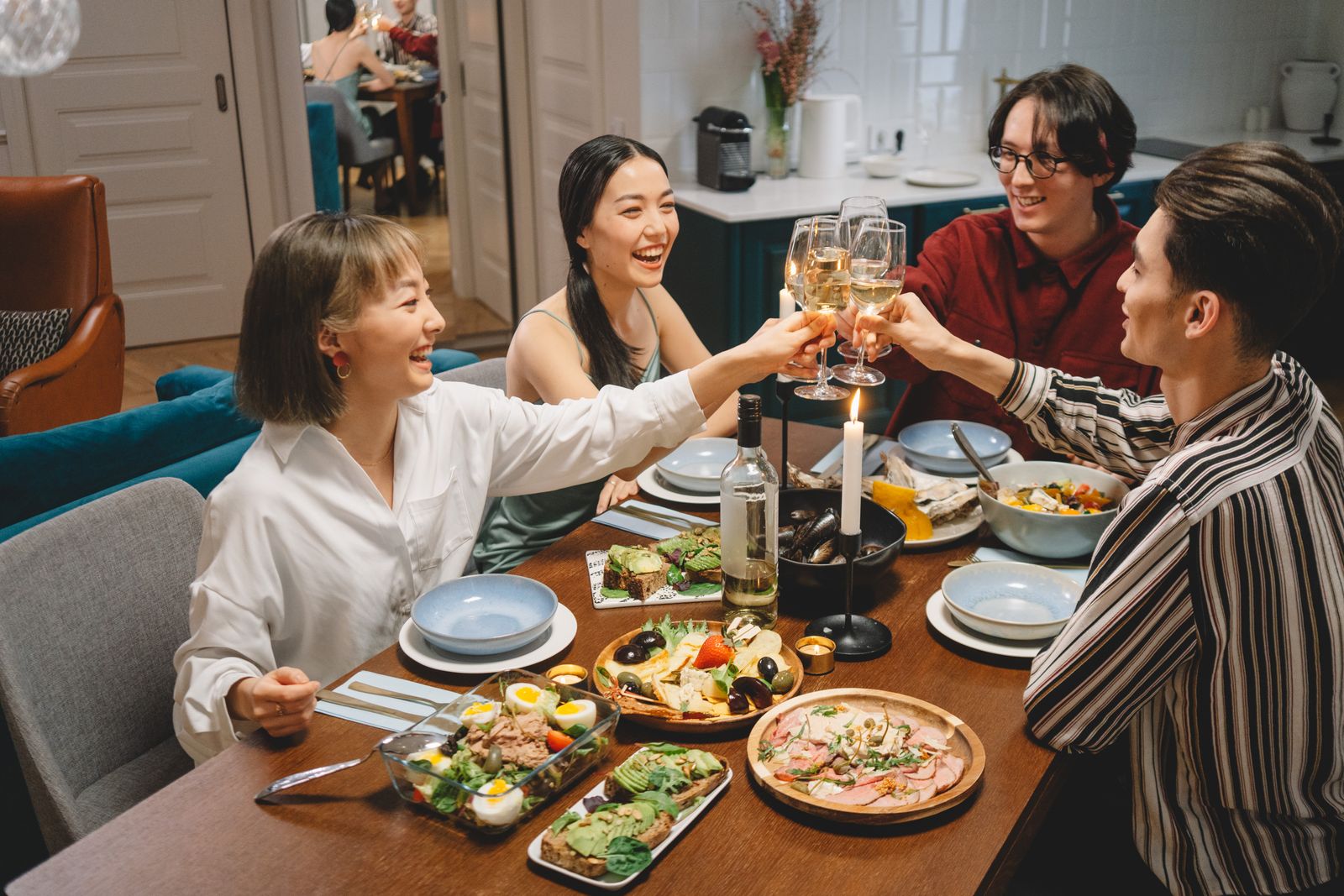
A Christmas party for 15 to 30 people is a format of its own. It is not simply a scaled-down version of a large corporate party. The room is smaller, the quiet is more audible, and every guest is visible. In a big hall someone can sit in a corner for an hour and nobody notices — in a group of twenty it is obvious immediately. That is exactly why a small team’s party calls for different decisions than an event for a hundred guests.
Below are the decisions that genuinely matter for a small company: the venue, the running order, the food, the entertainment and the photo zone.
The most common mistake is a room that is too big. Twenty people in a hall built for a hundred make the evening feel empty: voices echo, the dance floor stays bare, and the party never gets going. Look for a space that is slightly tight for your group — so that people sit and stand close to each other.
The advantage of a small party is that the choice of venues is far wider: a restaurant’s private room, a studio, your own larger office space, a small villa or a countryside house with a sauna. For a large event those options fall away.
A small party does not need ten programme points. Three or four fixed moments hold the evening together, and the rest of the time is for conversation. A workable structure looks roughly like this:
At a small party it is especially important that someone is responsible for the timing. The dynamic of a group of twenty shifts quickly: if the welcome speech stretches to fifteen minutes, the mood drops and it is hard to win back. We have written about building the programme in more detail in the organiser’s Christmas party checklist.
The choice between the two formats should be a deliberate one. A seated dinner suits a team that wants to talk and where people know each other well. The downside: a guest spends the whole evening with the two people beside them and never reaches anyone else.
A buffet or a table of snacks gets people moving and mixing. It works well when the team has new colleagues or several departments that rarely meet. The downside: nobody sits down, and some guests tire sooner.
A practical compromise for a small party: start with a seated meal, then partly clear the tables around the third course or move dessert to another part of the room. That way the first half of the evening gives you calm conversation and the second half gives you movement.
The biggest risk in a small group is pressure. If one person out of twenty is asked to perform, there is nowhere to hide. The formats that work are the ones where taking part is voluntary and natural:
If you want a clear theme for the party, Christmas party theme ideas suit a small group just as well as a large one — in a small room a theme is even easier to carry through, because less decor is needed.
People often say a small party has no room for a photo booth. In practice the equipment takes up about one square metre, and the backdrop is 1.5–2 metres wide and 2.5 metres high. That fits into the private room of most restaurants and into a larger office space too.
What actually matters in a small room:
If the room is narrow or the ceiling low, a photo mirror is worth considering: the controls are built into the mirror itself, the camera is vertical and the shot is full length. We have written separately about lighting and backdrop mistakes in our piece on the Christmas party photo zone.
The budget for a small party usually breaks into four parts: the venue, the catering, the equipment and entertainment, and the decor. The largest share goes to food, and the most frequently underestimated item is equipment and transport.
The timing logic is the same as for a large party: Friday and Saturday evenings in December are booked out in Tallinn and Tartu as early as September and October. A small group has an advantage here — you will still fit where a hundred-person party will not, and a weekday evening is often cheaper. Our post on when to book your Christmas party venue and gear goes into the schedule in more detail.
The main thing to understand about a small Christmas party is that fewer guests does not mean less preparation — it means a different kind of preparation. If you are planning a party for 15–30 people and want to know which photo zone or photo booth setup fits your room, get in touch and ask for a quote. We will go through the dimensions of the space and suggest an option that fits the running order of your evening.