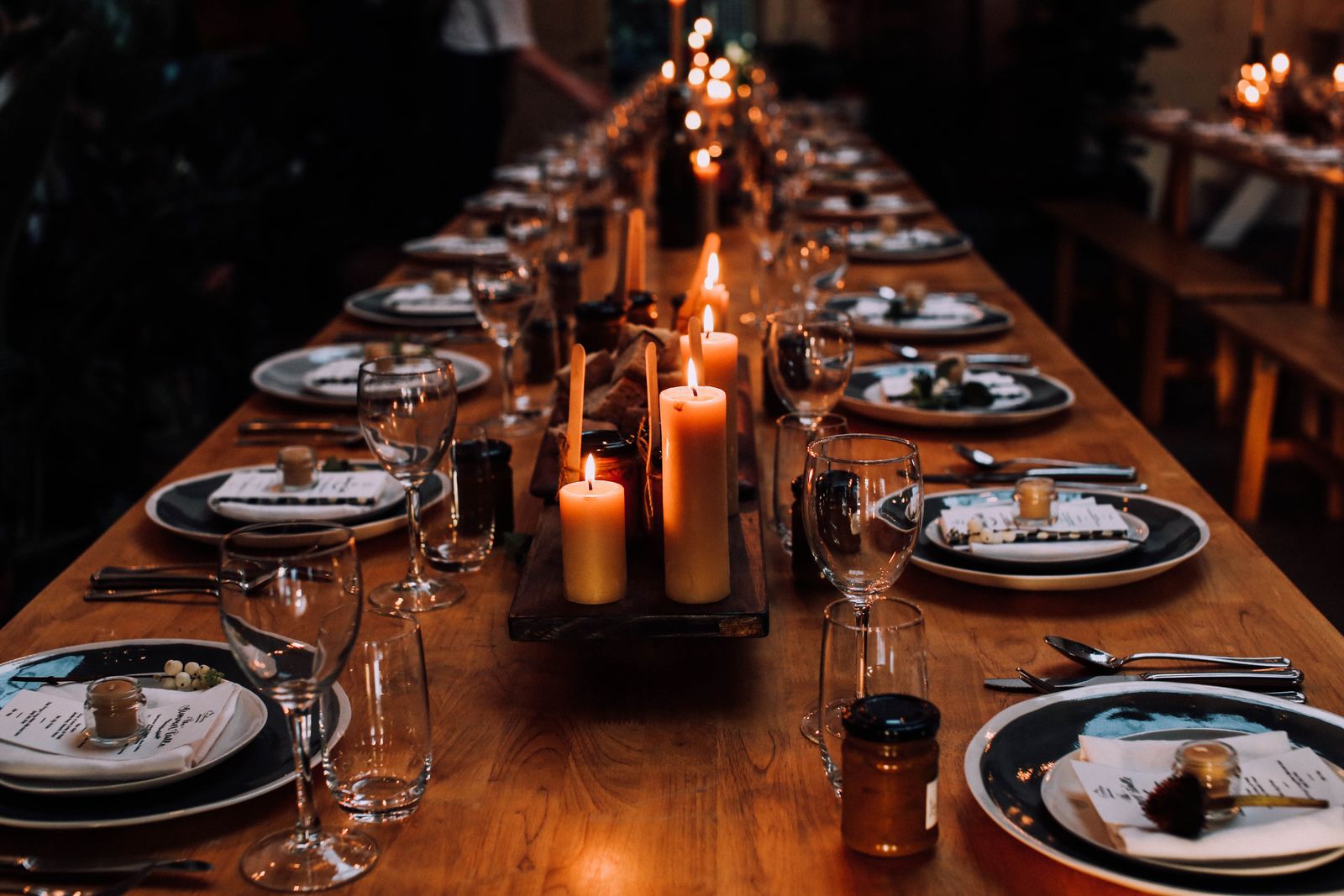
A 50th birthday is one of the few occasions that puts childhood friends, current colleagues, your own children and older relatives in the same room at the same time. That is exactly why an ordinary birthday plan does not work here. Some guests want to sit at the table and talk, others are waiting for the dancing, and a third group will leave well before midnight. What follows is a structure for the evening that keeps all three groups involved without anyone feeling left out.
Most anniversary plans start with the search for a venue and then get stuck because the list keeps growing or shrinking. Do it the other way round. Write the list first and split it into three circles: family, friends, and work and other acquaintances. Count each circle separately — that immediately tells you whether you are dealing with thirty people, for whom a separate room in a restaurant is enough, or eighty, who need a real hall, a cloakroom and proper sound equipment.
A list in three circles gives you one more thing. It shows how many of your guests do not know each other. If the two largest circles are strangers, the programme needs deliberate moments that mix people: a group photo, a table game, a short round of introductions by the host. Without them, the family sits in one corner all evening and the friends in another.
A party that starts around six in the evening and ends near midnight suits most 50th birthdays. Older guests have time to eat, hear the speeches and leave unhurried, while the younger ones stay for the dancing. If the party starts too early, an empty hour stretches between dinner and dancing. If it starts too late, half the programme simply never happens.
Plan the timeline in blocks rather than minutes. Arrival, dinner, speeches, the shared part, dancing. Each block needs a clear start — usually a couple of sentences from the host or a family member is enough for everyone to understand what happens next.
This is a framework, not a law. Only two rules really matter: the speeches do not start until everyone has eaten, and the dancing does not start until the cake has been cut. In the opposite order, the evening almost always splits into two separate parties.
The most common mistake is leaving the mingling to chance. A few simple moves help more than a long programme.
At a 50th birthday the photo zone works better than any other entertainment, because even the people who do not dance will go there. A grandmother and grandchild take one picture, colleagues take another, childhood friends a third — and everyone walks away holding a printed photo to take home.
Practical dimensions to plan for: the photo booth itself takes up about one square metre, the backdrop is 1.5–2 metres wide and 2.5 metres high, and the whole zone with room to move needs roughly three by three metres. Photos are printed on the spot in 10 × 15 cm format or as a 5 × 15 cm photo strip, and guests take them straight away.
If you want the zone to look more festive, the sequin “living backdrop” is a 150 € add-on that turns the corner into the most photographed spot of the evening. If the lighting in the room is dim — and at anniversary parties it usually is — read in advance why photos come out dark in the photo zone, because the fix is simple but has to be agreed before setup.
The choice of device depends on the crowd. A photo booth suits you if you want plenty of printed photos and a calm queue. A photo mirror, with the controls built into the mirror itself and a camera that captures people full height, works well for larger groups. A 360° platform that rotates around the guest and records slow motion lands best with a younger crowd. There is a longer comparison of the photo booth, photo mirror and 360° camera in a separate article.
Choosing music for a 50th is harder than for a wedding, because the age range in the room often spans fifty years. A simple solution: background music for the first two hours that does not get in the way of conversation, then an hour of recognisable songs from the birthday guest’s youth, and only after that more current dance music.
The host’s job is not to run games but to give the evening its shape. A good host announces the speeches, calls everyone to the group photo and signals when the cake is coming. With more than forty guests the difference is obvious. PicMe’s host and DJ is Ersto Põlluaas, and the programme is agreed before the event.
Write the order of speeches down and tell the speakers in advance. Three good speeches beat eight random ones. If someone insists on saying a few words and the programme is already full, give them a slot by the cake.
The printed photo goes home with the guest immediately, but the digital images have to be shared separately. Agree on how that works when you book: a gallery link, a QR code or e-mail. Practical options are described in the article on sharing photos with guests. For the person celebrating, this is often the most valuable part of the evening — a whole collection of pictures of everyone who was in one place at one time.
If the party is outside Tallinn — in Tartu, Pärnu, Narva, Viljandi or Rakvere — agree on transport and setup time when you book, not in the week of the event.
Anniversary parties are usually booked two to three months ahead, and earlier in autumn and December, when they compete with company Christmas parties. Send us the date, the city, the number of guests and the hours you want, and we will send a quote. Request a quote for your anniversary party here — we usually reply the same day.